
Chinese Card Identity Explorer
Oxidize — 氧化
Explore Oxidize in Chinese across 1 printings and 1 sets, with Traditional and Simplified Chinese versions, card text, artwork and release details.
- 1Total Chinese printings
- 0ZHTTraditional Chinese
- 1ZHSSimplified Chinese
- 1Sets
- 2004Chinese history
Card overview
- Mana cost
- {G}
- Card type
- Instant
- Latest rarity
- Uncommon
Oracle text
Destroy target artifact. It can't be regenerated.
Flavor text
「尘归尘,锈归锈。」\n~暗碧族祭师
Chinese printing milestones
These milestones are calculated from the Chinese printings currently recorded in the CTG database.
ZHT
—
ZHS
氧化
Chinese names and language variants
The same Magic card may have different printed names or wording between Traditional and Simplified Chinese editions. The versions below preserve the name and text printed on each physical card.
Traditional Chinese
No Traditional Chinese printed name recorded.
Simplified Chinese
氧化
Traditional Chinese name history
No printed-name history recorded for this script.
Simplified Chinese name history
- 氧化 Darksteel (DST)
1 distinct printed name(s) · 1 distinct printed-text version(s)
Traditional vs Simplified Chinese
Compare matching Chinese printings by set and collector number. Missing cells indicate that the corresponding printing is not currently recorded in the database.
Darksteel
DST · #79
Not recorded
Chinese printing timeline
A compact chronological view of every Traditional and Simplified Chinese printing recorded for this card identity.
Sets featuring this card in Chinese
All Chinese printings
Other cards with this Chinese name or character
Exact printed-name matches are shown first, followed by other Chinese card identities sharing characters with this card’s recorded Chinese names.
 Shared character: 化
Cockatrice
石化鸡蛇
Shared character: 化
Cockatrice
石化鸡蛇
 Shared character: 化
Living Artifact
活化神器
Shared character: 化
Living Artifact
活化神器
 Shared character: 化
Living Lands
活化土地
Shared character: 化
Living Lands
活化土地
 Shared character: 化
Magnetic Mountain
磁化岛山
Shared character: 化
Magnetic Mountain
磁化岛山
 Shared character: 化
Swords to Plowshares
化劍為犁
Shared character: 化
Swords to Plowshares
化劍為犁
 Shared character: 化
Ovinomancer
羊化术师
Shared character: 化
Ovinomancer
羊化术师
 Shared character: 化
Incinerate
焚化
Shared character: 化
Incinerate
焚化
 Shared character: 化
Contamination
污化
Shared character: 化
Contamination
污化
 Shared character: 化
Corrupt
腐化
Shared character: 化
Corrupt
腐化
 Shared character: 化
Vitalize
活力化
Shared character: 化
Vitalize
活力化
 Shared character: 化
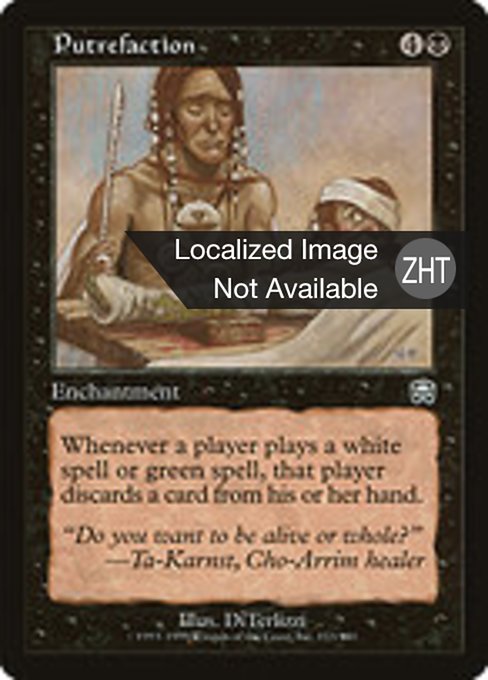
Putrefaction
溃烂化脓
Shared character: 化
Putrefaction
溃烂化脓
 Shared character: 化
Rewards of Diversity
多元化的犒赏
Shared character: 化
Rewards of Diversity
多元化的犒赏
 Auriok Glaivemaster
 Echoing Calm
 Emissary of Hope
 Hallow
 Leonin Battlemage
 Leonin Shikari
 Loxodon Mystic
 Metal Fatigue