
Chinese Card Identity Explorer
Rip-Clan Crasher — 撕肉族击破兵
Explore Rip-Clan Crasher in Chinese across 1 printings and 1 sets, with Traditional and Simplified Chinese versions, card text, artwork and release details.
- 1Total Chinese printings
- 0ZHTTraditional Chinese
- 1ZHSSimplified Chinese
- 1Sets
- 2008Chinese history
Card overview
- Mana cost
- {R}{G}
- Card type
- Creature — Human Warrior
- Latest rarity
- Common
Oracle text
Haste
Flavor text
如果你呼气,她将会与你战斗。 如果你吐火,她必须与你战斗。
Chinese printing milestones
These milestones are calculated from the Chinese printings currently recorded in the CTG database.
ZHT
—
ZHS
撕肉族击破兵
Chinese names and language variants
The same Magic card may have different printed names or wording between Traditional and Simplified Chinese editions. The versions below preserve the name and text printed on each physical card.
Traditional Chinese
No Traditional Chinese printed name recorded.
Simplified Chinese
撕肉族击破兵
Traditional Chinese name history
No printed-name history recorded for this script.
Simplified Chinese name history
- 撕肉族击破兵 Shards of Alara (ALA)
1 distinct printed name(s) · 1 distinct printed-text version(s)
Traditional vs Simplified Chinese
Compare matching Chinese printings by set and collector number. Missing cells indicate that the corresponding printing is not currently recorded in the database.
Shards of Alara
ALA · #189
Not recorded
Chinese printing timeline
A compact chronological view of every Traditional and Simplified Chinese printing recorded for this card identity.
Sets featuring this card in Chinese
All Chinese printings
Simplified Chinese
撕肉族击破兵
Rip-Clan Crasher
- Collector number
- 189
- Rarity
- Common
- Released
生物~人类/战士
Other cards with this Chinese name or character
Exact printed-name matches are shown first, followed by other Chinese card identities sharing characters with this card’s recorded Chinese names.
 Shared character: 击
Carrion Thrash
腐肉击族
Shared character: 击
Carrion Thrash
腐肉击族
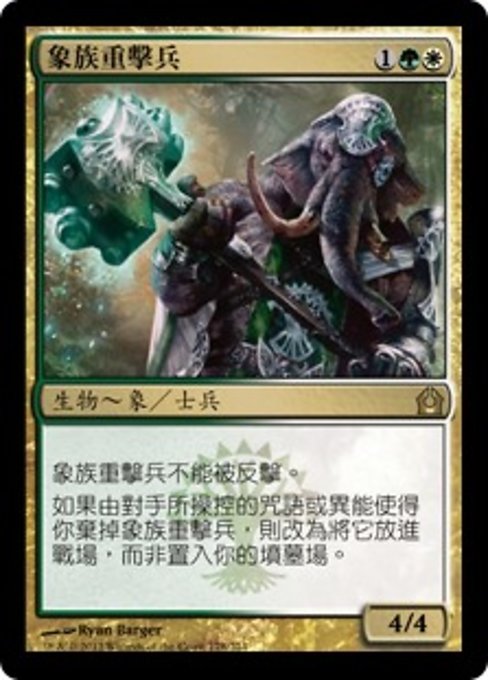 Shared character: 兵
Loxodon Smiter
象族重擊兵
Shared character: 兵
Loxodon Smiter
象族重擊兵
 Shared character: 兵
Lancers en-Kor
寇族枪骑兵
Shared character: 兵
Lancers en-Kor
寇族枪骑兵
 Shared character: 撕
Flesh Reaver
撕肉魔
Shared character: 撕
Flesh Reaver
撕肉魔
 Shared character: 兵
Hidden Guerrillas
匿形游击兵
Shared character: 兵
Hidden Guerrillas
匿形游击兵
 Shared character: 击
Smash
破碎击
Shared character: 击
Smash
破碎击
 Shared character: 兵
Skirk Commando
司克突击兵
Shared character: 兵
Skirk Commando
司克突击兵
 Shared character: 兵
Sunstrike Legionnaire
光击军团兵
Shared character: 兵
Sunstrike Legionnaire
光击军团兵
 Shared character: 兵
Swooping Talon
攫击兵
Shared character: 兵
Swooping Talon
攫击兵
 Shared character: 兵
Krark-Clan Grunt
喀勒克族蛮兵
Shared character: 兵
Krark-Clan Grunt
喀勒克族蛮兵
 Shared character: 撕
Rend Flesh
撕裂肉身
Shared character: 撕
Rend Flesh
撕裂肉身
 Shared character: 兵
Ordruun Commando
欧度鲁突击兵
Shared character: 兵
Ordruun Commando
欧度鲁突击兵
 Akrasan Squire
 Angel's Herald
 Angelic Benediction
 Angelsong
 Bant Battlemage
 Battlegrace Angel
 Cradle of Vitality
 Dispeller's Capsule