
Chinese Card Identity Explorer
Razorjaw Oni — 剃刀颚邪鬼
Explore Razorjaw Oni in Chinese across 1 printings and 1 sets, with Traditional and Simplified Chinese versions, card text, artwork and release details.
- 1Total Chinese printings
- 0ZHTTraditional Chinese
- 1ZHSSimplified Chinese
- 1Sets
- 2005Chinese history
Card overview
- Mana cost
- {3}{B}
- Card type
- Creature — Demon Spirit
- Latest rarity
- Uncommon
Oracle text
Black creatures can't block.
Flavor text
他一咬牙,战场便充斥着兵器交锋的声响。
Chinese printing milestones
These milestones are calculated from the Chinese printings currently recorded in the CTG database.
ZHT
—
ZHS
剃刀颚邪鬼
Chinese names and language variants
The same Magic card may have different printed names or wording between Traditional and Simplified Chinese editions. The versions below preserve the name and text printed on each physical card.
Traditional Chinese
No Traditional Chinese printed name recorded.
Simplified Chinese
剃刀颚邪鬼
Traditional Chinese name history
No printed-name history recorded for this script.
Simplified Chinese name history
- 剃刀颚邪鬼 Saviors of Kamigawa (SOK)
1 distinct printed name(s) · 1 distinct printed-text version(s)
Traditional vs Simplified Chinese
Compare matching Chinese printings by set and collector number. Missing cells indicate that the corresponding printing is not currently recorded in the database.
Saviors of Kamigawa
SOK · #87
Not recorded
Chinese printing timeline
A compact chronological view of every Traditional and Simplified Chinese printing recorded for this card identity.
Sets featuring this card in Chinese
All Chinese printings
Simplified Chinese
剃刀颚邪鬼
Razorjaw Oni
- Collector number
- 87
- Rarity
- Uncommon
- Released
生物~恶魔/精怪
Other cards with this Chinese name or character
Exact printed-name matches are shown first, followed by other Chinese card identities sharing characters with this card’s recorded Chinese names.
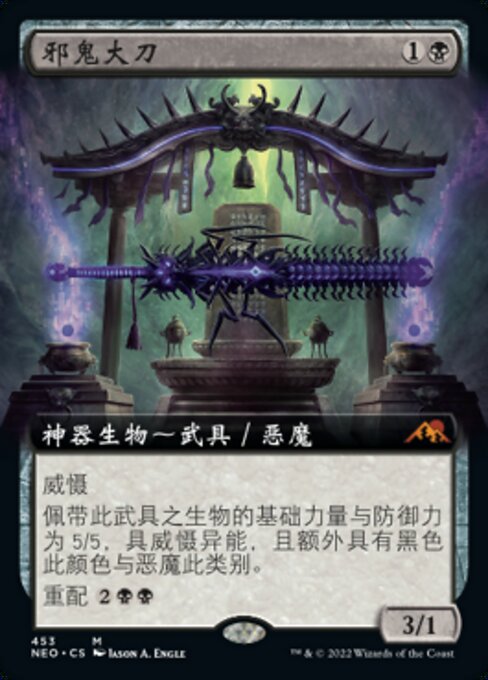 Shared character: 刀
Blade of the Oni
邪鬼大刀
Shared character: 刀
Blade of the Oni
邪鬼大刀
 Shared character: 邪
Mesmeric Fiend
催眠邪鬼
Shared character: 邪
Mesmeric Fiend
催眠邪鬼
 Shared character: 邪
Gutwrencher Oni
绞脏邪鬼
Shared character: 邪
Gutwrencher Oni
绞脏邪鬼
 Shared character: 邪
Oni Possession
邪鬼夺身
Shared character: 邪
Oni Possession
邪鬼夺身
 Shared character: 邪
Painwracker Oni
激痛邪鬼
Shared character: 邪
Painwracker Oni
激痛邪鬼
 Shared character: 邪
Ink-Eyes, Servant of Oni
邪鬼仆役墨目
Shared character: 邪
Ink-Eyes, Servant of Oni
邪鬼仆役墨目
 Shared character: 邪
Mark of the Oni
邪鬼印记
Shared character: 邪
Mark of the Oni
邪鬼印记
 Shared character: 邪
Oni of Wild Places
野地邪鬼
Shared character: 邪
Oni of Wild Places
野地邪鬼
 Shared character: 邪
Tectonic Fiend
地壳邪鬼
Shared character: 邪
Tectonic Fiend
地壳邪鬼
 Shared character: 邪
Glaze Fiend
嵌璃邪鬼
Shared character: 邪
Glaze Fiend
嵌璃邪鬼
 Shared character: 邪
Tar Fiend
焦油邪鬼
Shared character: 邪
Tar Fiend
焦油邪鬼
 Shared character: 邪
Vampire Hexmage
邪術吸血鬼
Shared character: 邪
Vampire Hexmage
邪術吸血鬼
 Aether Shockwave
 Araba Mothrider
 Celestial Kirin
 Charge Across the Araba
 Cowed by Wisdom
 Curtain of Light
 Descendant of Kiyomaro
 Eiganjo Free-Riders